
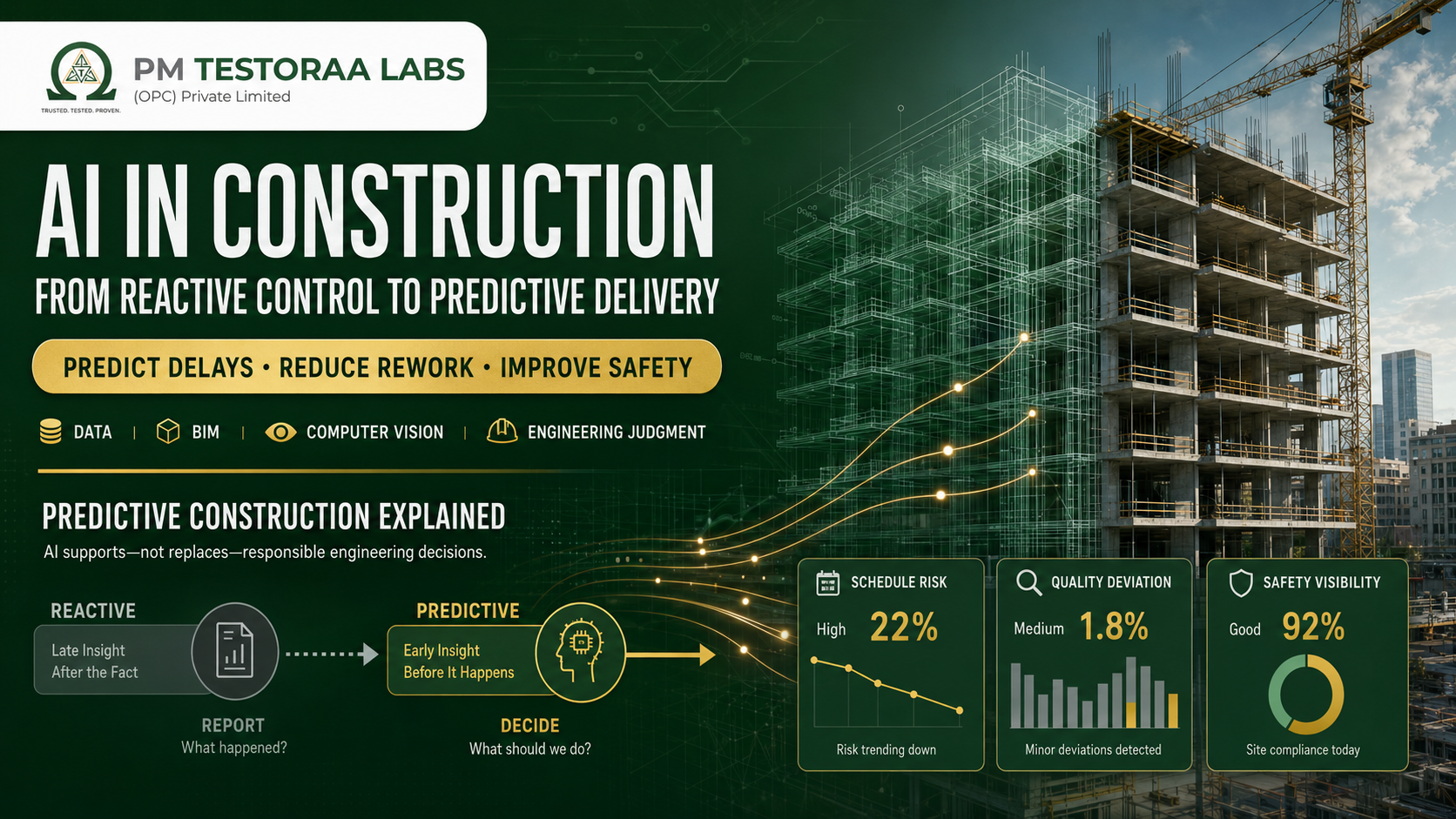

Artificial Intelligence · Project Controls · Construction Engineering
AI in Construction: From Reactive Project Control to Predictive Building Delivery
How connected project data, computer vision and machine learning can reveal delay, cost, quality and safety risks earlier—and why experienced engineers must remain responsible for every consequential decision.
The quick answer
Construction AI is moving beyond chatbots and automated reports. Its more important role is to help project teams recognise patterns early: which activity is likely to slip, which package may exceed budget, where installed work differs from the model, which procurement item may interrupt the critical path, and where quality or safety attention is needed first.
This is what LOGIC Consulting calls a shift from fragmented delivery to predictive construction. Information from schedules, BIM models, cost systems, procurement logs, cameras, sensors, quality records and past projects is connected. Algorithms compare planned and actual performance, estimate future risk and alert people while there is still time to intervene.
In common language: conventional project control often explains yesterday’s problem. Predictive project control tries to identify tomorrow’s problem today. It does not remove uncertainty; it gives the engineer, project manager and owner an earlier, more organised basis for action.
The principle is powerful, but the software is not an engineer of record. AI can produce false alarms, miss uncommon hazards, repeat errors hidden in historical data and generate confident but incorrect text. Reliable adoption therefore requires structured information, tested models, human review, clear responsibility, cybersecurity, privacy controls and an auditable record of how decisions were made.
What the Consultancy-ME report actually says
The Consultancy-ME article published on 30 July 2026 summarises an insight paper by LOGIC Consulting titled “The Role of AI in the Construction Industry—From Fragmented Delivery to Predictive Construction.” Its central argument is that project scale is growing faster than delivery productivity and that disconnected, delayed or unreliable information weakens decisions from tendering through final control.
The original LOGIC article reports that global construction spending could rise from approximately USD 13 trillion in 2023 to USD 22 trillion by 2040, while global construction productivity grew by only about 0.4% per year from 2000 to 2022, compared with roughly 2% for the overall economy. The Consultancy-ME summary writes “billion” for the spending values; the original source uses “trillion,” which is the credible unit and is used here.
Rework and weak informationLOGIC reports that rework may account for 3–11% of total project cost, with document management and quality-control weaknesses among the causes.
Digitisation before predictionThe insight says digitising documents and quality workflows can reduce avoidable costs by more than 50% in the cited context. This is a source claim, not a guaranteed saving for every project.
Uneven AI adoptionFor 2025, the paper reports about 45% of organisations with no AI implementation, 34% in early pilots, only 1.5% using AI across multiple processes and less than 1% fully embedded.
Human expertise remains centralLOGIC’s conclusion is that firms should use AI to strengthen construction expertise, not replace it.
The report also highlights a measurement problem: firms use “productivity” to mean different things—output per worker, output per hour, unit cost, schedule performance or progress against plan. If organisations cannot agree on the outcome being measured, an AI model cannot make their projects comparable by magic.
Source caution: several figures in the insight are compiled from external studies and vendor cases. They are valuable signals, but they should not be copied into a project business case without checking the original definition, geography, sample, baseline and calculation method.
What “predictive construction” means
Predictive construction is a management approach in which current and historical project information is used to estimate likely future outcomes. The result may be a probability, forecast range, risk score or ranked list of items requiring attention. It is not a digital crystal ball and it does not mean fully automated construction.
| Control mode | Main question | Typical information | Example response |
|---|---|---|---|
| Descriptive | What happened? | Daily report, actual quantity, photographs, cost posted to date. | Confirm that slab work completed two days late. |
| Diagnostic | Why did it happen? | Delay event, labour record, RFI, material delivery and sequence. | Identify late embed approval and reduced formwork crew. |
| Predictive | What is likely to happen next? | Current production rate, remaining quantity, dependencies and historical variability. | Forecast a high probability of missing the next milestone. |
| Prescriptive support | Which response may work best? | Scenario simulation, resource limits, cost and schedule objectives. | Compare resequencing, added shift or alternative supplier. |
| Governed decision | What will the authorised team do? | Model output plus engineering, commercial, safety and contractual review. | Approve a mitigation plan, owner and verification date. |
Only the last row creates project action. A model can rank schedule risks, but the project manager knows whether an access restriction is temporary. Computer vision can identify missing installations, but the site engineer knows whether the photograph is current and whether an approved design change exists. An optimisation engine can recommend overtime, but management must consider fatigue, safety, labour law, productivity loss and cost.
Prediction is probabilistic
A useful forecast should communicate uncertainty. “Activity A will be late” sounds certain. “Based on the last four updates, Activity A has an estimated 75% probability of finishing more than five days late if production and material availability remain unchanged” is more honest and more actionable. The team can then decide which assumptions to challenge.
How the predictive construction loop works
Capture reality
Structure and validate
Compare with plan
Predict and prioritise
Act and learn
1. Capture reality
Project reality enters through schedule updates, labour and equipment records, delivery receipts, cost commitments, BIM objects, RFIs, non-conformance reports, inspection results, photographs, drone imagery, equipment telematics, environmental sensors and sometimes structural-health-monitoring devices. More data is not automatically better. It must be relevant, timestamped and traceable.
2. Structure and validate
Names and codes must mean the same thing across systems. A concrete pour identified as “Level 3 Zone B” in the schedule should not be “L03-East” in cost control and “Third Floor” in the quality log without an agreed mapping. Duplicate records, missing dates, late updates and unapproved model revisions must be detected before training or prediction.
3. Compare with an agreed baseline
The algorithm needs a reference: approved programme, cost plan, BIM model, inspection-and-test plan, safety rule or expected production range. Baselines must be version controlled. If the design changes but the model is not updated, the system may correctly detect a difference yet incorrectly label authorised work as a defect.
4. Predict and prioritise
Machine-learning models identify patterns associated with delay, cost growth, rework or hazard. Simulation may test alternative sequences. Computer vision can classify installed objects or unsafe conditions. Natural-language systems can search contracts, specifications and past correspondence. Outputs should include confidence, supporting evidence and the date of the data used.
5. Act, verify and learn
A named person reviews the alert, records acceptance or rejection, assigns mitigation and checks the result. This feedback is essential. If users silently ignore poor alerts, the organisation learns nothing. If a model’s recommendations are accepted without review, automation bias replaces engineering control.
Ground truth matters: an AI dashboard is only as reliable as the field evidence used to confirm it. Site measurements, approved drawings, material tests, inspection records and competent observation remain the reference against which digital predictions must be checked.
Where AI can add value across a construction project
Tendering and bid/no-bid decisions
The news report describes tendering as the first layer of project control because commitments made in the bid are inherited by the execution team. AI can structure opportunity scoring using client payment history, scope clarity, cash-flow demand, delivery capacity, workforce availability, location, contract conditions and previous win/loss data.
This can improve consistency, but it may also reproduce past bias. A contractor that historically avoided a market may have little data proving it can succeed there. The scoring tool should reveal which factors drove the result and allow authorised override with reasons.
Estimating and quantity intelligence
AI-assisted tools can classify drawing elements, compare specifications, suggest quantities and flag missing scope. Historical rates can support estimate ranges and identify abnormal pricing. However, design maturity, local market conditions, taxes, lead times, wastage and temporary works still require professional judgment. Generated quantities must be checked against measurement rules and current drawings.
Planning, scheduling and delay-risk prediction
Models can analyse activity logic, floats, production rates, resource constraints, procurement dates and previous delay patterns. Rather than showing only the critical path, they can identify near-critical chains and activities whose variability makes them likely future constraints. Scenario engines can compare resequencing or resource changes before field implementation.
Progress monitoring with computer vision
Images or 360-degree video can be aligned with BIM and schedule objects to estimate installed work. Repeated capture creates an objective record and can reveal trade areas falling behind. Reliable operation needs consistent routes, adequate lighting, current models, correct object definitions and human resolution of occlusion or changed design.
Quality control and rework prevention
AI can search inspection records for recurring defects, identify trades or locations with rising NCR frequency, compare photographs with approved details and predict where additional inspection may reduce risk. It should guide attention—not waive required inspections. A predicted “low-risk” pour still needs the specified reinforcement, formwork, pre-pour checklist and concrete tests.
Safety monitoring
Computer vision may flag missing PPE, people entering exclusion zones, work at height, proximity to plant or unsafe housekeeping. Sensors can detect gas, temperature, vibration or equipment state. False negatives can be dangerous and false positives can create alarm fatigue. AI safety monitoring supplements trained supervision, permits, toolbox talks, barriers and emergency procedures.
Cost, cash flow and commercial exposure
Forecasting models can combine committed cost, installed quantity, productivity, changes, claims, procurement and programme risk to update estimated cost at completion. Natural-language tools may classify contract notices or summarise correspondence. Legal and commercial teams must verify clauses, dates, entitlement and confidentiality; generative text is not a contractual opinion.
Material planning and sustainability
Better demand forecasting can reduce over-ordering, emergency transport, idle inventory and waste. Optimisation can compare material options using cost, carbon, availability and performance constraints. Environmental conclusions require verified quantities and compatible EPD/LCA data; an AI recommendation does not certify a product as sustainable.
Handover and asset operations
During operation, sensor and maintenance histories can support predictive maintenance for pumps, lifts, HVAC, electrical systems and selected structural assets. A searchable information model can connect equipment, warranties, test certificates and inspection history. The value depends on whether construction information is complete, verified and transferred in a maintainable format.
What the Intel–Buildots example demonstrates—and what it does not
Consultancy-ME cites Intel’s use of Buildots on semiconductor fabrication facilities as evidence of AI-enabled progress control. Buildots’ current case-study page reports a 4.3% saving in rework costs per fabrication facility, automatic progress tracking and 1,176 model updates or changes per facility. It attributes benefits to early deviation detection, BIM-to-site comparison and performance benchmarking across projects.
The delay number requires caution. The Buildots page headline says six weeks of delay avoided per facility, while the detailed solution and results text says approximately four weeks. Consultancy-ME repeats six weeks. Because the vendor page is internally inconsistent, the prudent conclusion is qualitative: the project team reports that earlier detection helped avoid material delay, but the exact figure should be verified from the underlying case-study methodology before reuse.
| What the case supports | What it does not prove |
|---|---|
| Computer vision and model comparison can scale progress visibility on a very large, highly digitised project. | Every contractor will save 4.3% in rework. |
| Early identification of deviations can create time for corrective action. | AI alone caused every reported saving; process, people and project context also matter. |
| Repeated model updates can improve as-built accuracy and learning across similar facilities. | A small project without BIM, stable work packages or disciplined capture will achieve the same result. |
| A major owner can integrate AI into project-control workflows at scale. | The vendor case is independent peer-reviewed proof or a universal ROI benchmark. |
Case studies should therefore help frame a pilot hypothesis, not predetermine the business case. An Indian project might test whether weekly 360-degree capture reduces progress-verification time or whether NCR analytics identifies recurring workmanship issues earlier. Savings should be measured against that project’s own baseline.
BIM, digital twins and AI: related, but not the same
BIMA structured digital representation of asset information, geometry and relationships.
Digital twinA digital representation linked to the changing state of a physical asset through data.
AIMethods that classify, predict, generate or optimise using patterns in information.
A BIM model can exist without AI. An AI forecasting model can work from schedule and cost tables without a three-dimensional model. A digital twin needs a defined connection between the physical asset and its digital representation; a visually impressive 3D model with no current data is not automatically a twin.
When combined responsibly, the technologies reinforce one another. BIM supplies object identity and planned geometry. Cameras or scanners describe installed reality. Sensors provide changing operational state. AI helps match, classify and forecast. The engineer or asset manager then decides what action is justified.
ISO 19650 provides a recognised information-management framework for BIM across the asset lifecycle. Its concepts—clear information requirements, defined responsibilities, version control, review and exchange—are valuable because AI needs governed information. If project teams do not know which drawing is approved, adding a prediction engine increases the speed of confusion.
Reliable prediction = relevant data × consistent structure × valid model × responsible human action
Why AI predictions can fail on construction projects
Poor data qualityMissing updates, inconsistent coding, wrong quantities and stale models teach the system an inaccurate version of reality.
Unrepresentative historyA model trained on high-rise interiors may not understand bridge rehabilitation, monsoon logistics or local labour practices.
Data leakageIf information that becomes known only after an event is accidentally included during training, apparent accuracy will collapse in live use.
Model driftPerformance can change when suppliers, designs, crews, methods, seasons or commercial conditions differ from training data.
False positivesToo many incorrect warnings consume attention and cause users to ignore genuine risks.
False negativesA missed defect or hazard may create a false sense of safety, particularly in quality or HSE applications.
Automation biasPeople may accept a ranked recommendation because it looks mathematical, even when site evidence contradicts it.
Black-box decisionsIf the team cannot understand the factors behind a risk score, accountability and correction become difficult.
Privacy and surveillanceSite images may capture faces, vehicle plates, behaviour and personal data beyond the intended engineering purpose.
Cyber and IP exposureDrawings, rates, contracts, security layouts and client information can leak through poorly governed cloud or generative-AI tools.
Contractual ambiguityParties may disagree over ownership of data, admissibility of automated records and liability for a missed or incorrect alert.
Vendor dependenceClosed formats and proprietary training can make it difficult to move data, reproduce a result or continue after a subscription ends.
Generative AI needs special control
Large language models can draft reports, summarise meetings, search specifications and explain dashboards. They can also invent clauses, standards, dates and calculations. Every technical statement, contractual reference and numerical result must be checked against the approved source. Sensitive project material should be used only in authorised environments under the organisation’s data policy.
Computer vision is not direct measurement
An image model estimates what pixels represent. It may confuse temporary and permanent work, miss concealed reinforcement, misread scale or fail under dust, darkness and occlusion. Where dimensional compliance matters, use calibrated survey, scanning or test methods. Where structural capacity matters, use engineering analysis and material evidence.
A governance checklist for construction AI
| Control | Question to answer before deployment |
|---|---|
| Purpose | Which decision will the system support, and what measurable problem is being reduced? |
| Owner | Who is accountable for the use case, data, model performance, user training and incident response? |
| Data authority | Who owns each dataset, who may access it, how long is it retained and may it train the vendor’s models? |
| Baseline | How are current cost, delay, rework, safety or processing time measured before AI? |
| Validation | Was the model tested on representative projects, seasons, trades and site conditions? |
| Thresholds | What confidence or risk level triggers review, and what happens after an alert? |
| Human authority | Which professional must approve any safety, structural, contractual or commercial action? |
| Traceability | Can the team reconstruct the input data, model version, output, reviewer and final decision? |
| Monitoring | How will false alarms, missed events, drift, user overrides and realised benefits be tracked? |
| Exit | Can data and records be exported in usable formats if the tool or vendor changes? |
ISO/IEC 42001:2023 provides a management-system framework for governing AI risks and opportunities. ISO/IEC 23894:2023 provides AI-specific risk-management guidance. These standards do not validate a construction prediction by themselves, but their governance principles—policies, roles, risk assessment, monitoring and continual improvement—are useful for owners and contractors.
What predictive construction means for India
India’s construction environment is ideal for high-value AI use cases because projects combine large scale, varied subcontractors, rapid delivery, complex approvals, monsoon effects, material-price volatility and substantial field documentation. It is also challenging because digital maturity differs widely between organisations and projects.
Start with the workflow, not the software
A contractor still relying on unstructured WhatsApp photographs, delayed spreadsheets and inconsistent activity codes will not become predictive by purchasing a dashboard. The first investment is information discipline: common work-breakdown structure, cost codes, drawing register, RFI and NCR workflow, daily quantities, procurement dates and current programme.
Design for site reality
Connectivity may be unreliable. Labour and equipment records may be multilingual. Small subcontractors may not use enterprise platforms. Camera capture can be affected by dust, rain, glare and access. A practical system should work offline where required, minimise duplicate data entry and provide a clear benefit to the people asked to supply data.
Keep professional and statutory responsibility clear
AI does not replace compliance with approved drawings, contracts, National Building Code provisions, Indian Standards, test methods, safety regulations or authority approvals. A predicted low risk does not authorise omission of mandatory inspection or testing. Structural design, stability certification and safety-critical decisions must remain under competent authorised professionals.
Protect project and personal data
Site video, attendance, worker behaviour, medical events, identification and access data may involve privacy obligations. Contracts, rates, claims and drawings may be commercially sensitive or security-relevant. Organisations should apply the Digital Personal Data Protection framework and other applicable Indian requirements, define purpose and retention, control access, secure transfers and review whether information leaves the approved environment.
Build responsible AI capacity
India’s AI policy direction emphasises data quality, responsible and inclusive adoption, safety evaluation and context-specific systems. Construction organisations need multidisciplinary teams: project controls, engineering, field operations, quality, safety, contracts, IT, cybersecurity and data science. A technically impressive model without operational ownership will remain a pilot.
A practical implementation roadmap
Choose one costly, measurable problem. Examples: late progress visibility, repeated NCRs, delayed material approvals or unreliable cash-flow forecasts. Avoid the vague objective “use AI.”
Define baseline and decision. Measure current processing time, rework, forecast error or delay detection. Name who will act when the model alerts.
Audit data readiness. Check completeness, coding, timestamps, approvals, access rights and representative history. Repair the workflow before training.
Run a limited pilot. Select one project, package or zone with committed users. Keep the existing control process available during evaluation.
Operate in shadow mode. Let the model predict without controlling work. Compare outputs with actual outcomes and document false positives, false negatives and user interpretation.
Set human-review rules. Define confidence thresholds, escalation, override, approval and prohibited automated decisions—especially for safety and structure.
Integrate the workflow. Connect the validated output to RFI, schedule, inspection, procurement or risk-management processes so alerts lead to named actions.
Scale only after measured value. Compare benefits with software, capture, integration, training and change-management costs. Monitor performance after scaling.
Suggested maturity stages
| Stage | Project behaviour | Next priority |
|---|---|---|
| 0 — Fragmented | Paper, messages and isolated spreadsheets; no trusted common baseline. | Digitise core records and define ownership. |
| 1 — Consistent | Standard codes, controlled documents and regular updates. | Improve quality and connect systems. |
| 2 — Connected | Schedule, cost, BIM, procurement and field evidence can be linked. | Develop dashboards and clean training datasets. |
| 3 — Predictive | Validated models forecast selected risks with known confidence and human review. | Measure drift, benefits and failure modes. |
| 4 — Learning organisation | Lessons and performance benchmarks improve future projects and decisions. | Maintain governance; never remove accountable human authority. |
KPIs that reveal real value
- days earlier that a likely delay is identified;
- forecast error for cost and completion date;
- percentage of alerts reviewed, accepted, rejected and resolved;
- false-positive and false-negative rates;
- time required for progress verification and reporting;
- rework cost and repeat-NCR frequency;
- inspection coverage and closure time;
- material waste and emergency deliveries;
- user adoption, override reasons and data completeness;
- total cost of capture, software, integration, training and governance.
What AI means for testing, NDT and structural assessment
For laboratories and structural engineers, AI can organise inspection photographs, map cracks, compare repeat surveys, prioritise anomalous NDT readings and combine time-series information from sensors. It can help identify where additional investigation is likely to be most useful. These capabilities can improve consistency and reduce time spent searching records.
But AI does not convert indirect evidence into certainty. A computer-vision crack width must be calibrated to scale and camera geometry. A predicted concrete-strength value does not replace testing to the applicable method. Rebound hammer, UPV, half-cell potential, cover measurement, carbonation, cores and load assessment each have specific purposes and limitations. Structural capacity still requires a competent engineer to interpret load paths, material evidence, deterioration and uncertainty.
Do not train a safety conclusion from poor labels. If historical reports classify every low UPV value as “unsafe” or use rebound number as exact in-situ strength without correlation, an AI model will reproduce the same technical error more quickly.
The best use of AI in engineering investigation is decision support: better defect registers, traceable data, anomaly ranking, monitored change and clearer links between observation, test, diagnosis and action. The field test remains the ground truth; the engineer remains responsible for the conclusion.
Common misunderstandings
“AI will run the project.”AI can forecast and organise information. People remain responsible for contracts, engineering, safety, sequencing and leadership.
“More data guarantees accuracy.”Large quantities of stale, biased or inconsistent data can make a model confidently wrong.
“A digital twin is a 3D model.”A twin needs maintained links to the physical asset and defined operational information—not only geometry.
“Computer vision replaces inspection.”It can extend coverage and flag anomalies, but concealment, scale and context still require competent inspection and measurement.
“The vendor’s saving is our ROI.”Case-study benefits depend on baseline, project type, maturity and method. Run a project-specific pilot.
“AI output is objective.”Data selection, labels, thresholds and model design reflect human choices and can introduce bias.
“A chatbot knows the latest code.”Generative systems can invent clauses or use outdated text. Verify every requirement against the official current source.
“Prediction removes uncertainty.”A useful model quantifies uncertainty and supports earlier action; it does not promise the future.
Frequently asked questions
What is predictive construction?
It is the use of current and historical project information to estimate future cost, schedule, quality, resource or safety outcomes so teams can intervene earlier. Predictions should be probabilistic, validated and reviewed by responsible professionals.
Is predictive construction the same as a digital twin?
No. A digital twin is a maintained digital representation linked to a physical asset. Predictive analytics may use twin data, but it can also operate on schedules, cost records or inspection histories without a full twin.
Can AI prepare a construction schedule?
AI can suggest sequences, durations and resource scenarios. A planner and project team must verify construction method, approvals, access, contractual milestones, productivity, safety and real constraints before adoption.
Can AI certify construction quality?
No. It can identify patterns, compare imagery and prioritise inspection. Acceptance still depends on approved specifications, competent inspection and applicable material or performance tests.
Can cameras automatically measure progress?
Computer vision can estimate recognised installed elements when capture, BIM objects and schedule mappings are suitable. Occlusion, temporary work, design changes and poor imagery require human review.
Will AI replace project managers and engineers?
It will automate some repetitive analysis and reporting, but responsibility, judgment, negotiation, site leadership and safety-critical decisions remain human professional functions.
What data should a contractor digitise first?
Begin with the approved programme, work-breakdown and cost codes, drawing register, RFIs, submittals, NCRs, daily quantities, labour/equipment records, procurement commitments and change log.
How should a small contractor start?
Choose one narrow problem and use existing project data. A structured daily-progress and delay-risk pilot may create more value than a costly enterprise platform introduced before workflows are consistent.
How do we evaluate an AI vendor?
Ask about relevant training data, validation performance, false-positive and false-negative rates, explainability, integration, cybersecurity, data ownership, retention, model updates, audit logs, export and exit arrangements.
What is the biggest adoption risk?
Poor information discipline. If teams do not maintain accurate baselines and timely records, AI amplifies inconsistency rather than creating predictability.
How PM Testoraa Labs can support data-grounded engineering
PM TESTORAA LABS (OPC) Private Limited supports material testing, non-destructive testing, structural audit, concrete assessment and durability investigation. In a predictive workflow, these verified field observations and test results provide the physical evidence against which digital assumptions can be checked.
Our support can include structured defect mapping, rebound-hammer and ultrasonic pulse-velocity testing, reinforcement scanning, half-cell corrosion-potential mapping, carbonation assessment, concrete core testing, condition monitoring and traceable engineering documentation within the scope of applicable methods.
Where project teams are building digital inspection registers or monitoring programmes, Testoraa Labs can help define test locations, consistent identifiers, repeatable formats and technically valid interpretation so that future analytics begin with dependable engineering data.
Planning a data-driven construction or building-assessment workflow?
Begin with reliable field evidence, consistent records and a clearly defined engineering decision. Technology creates value when it improves action—not when it merely adds another dashboard.
References
- Consultancy-ME, “AI in construction shifting to predictive building: LOGIC Consulting insight,” 30 July 2026.
- LOGIC Consulting, “The Role of AI in the Construction Industry—From Fragmented Delivery to Predictive Construction,” 2026.
- Buildots, “Intel uses Buildots’ AI to boost efficiency and reduce costs in fab construction,” vendor case study accessed 1 August 2026.
- ISO 19650-1:2018, information management using building information modelling—concepts and principles, confirmed current in 2024 with revision under development.
- ISO 19650-2:2018, information management using BIM during the delivery phase, confirmed current in 2024 with revision under development.
- ISO/IEC 42001:2023, Artificial Intelligence Management System.
- ISO/IEC 23894:2023, Artificial Intelligence—Guidance on Risk Management.
- Ministry of Electronics and Information Technology, India, AI governance guidelines development and public consultation.
- NITI Aayog, “AI for Viksit Bharat: The Opportunity for Accelerated Economic Growth,” 2025.
- Applicable current construction contracts, project specifications, National Building Code provisions, Indian Standards, safety requirements, data-protection obligations and authority approvals must be confirmed for each project.
Technical disclaimer: This article is an independent educational interpretation of public sources available up to 1 August 2026. It is not an endorsement of LOGIC Consulting, Buildots or any software product; not an AI, legal, contractual, cybersecurity or data-protection audit; and not a substitute for approved construction documents, statutory requirements, physical inspection, testing or competent engineering judgment. Reported savings are source-specific case-study claims and are not guaranteed outcomes. AI predictions must be validated for the intended project and used under accountable human oversight.