

Concrete Durability · Bio-Materials · Engineering Evidence
Self-Healing Concrete: How Bacteria Turn Small Cracks into Limestone
The science behind bacteria-based concrete, what “healing” really means, where the technology may help—and why structural cracks still require professional investigation.
The quick answer
Yes—selected bacteria can be incorporated into a cementitious healing system so that, when water reaches a small crack, dormant spores become active and contribute to the formation of calcium carbonate, the mineral commonly found in limestone. The resulting mineral deposit can seal the crack, reduce water passage and slow the entry of substances that promote reinforcement corrosion.
The pioneering work is closely associated with microbiologist Professor Henk Jonkers and colleagues at Delft University of Technology in the Netherlands. Their research brought microbiology and concrete technology together: alkali-resistant, spore-forming bacteria were paired with a suitable nutrient or mineral precursor and protected within the concrete. Laboratory studies and demonstrator projects have shown that bacteria-based systems can improve crack sealing and liquid tightness under appropriate conditions.
The essential engineering distinction: sealing a small crack is not the same as restoring the full structural strength of a damaged member. Bacterial mineralisation may close a pathway for water and improve durability, but it does not reconnect fractured reinforcing bars, reverse foundation settlement, correct an inadequate design or make a severely distressed building safe.
A recent Times of India science article described the concept as bacteria “turning cracks into stone” and highlighted the potential to save large maintenance costs. The phrase is an effective public explanation, but the likely savings are potential and project-dependent. Crack width, movement, water availability, temperature, healing-agent dosage, concrete composition, exposure, construction quality and service life all affect performance.
Research outcomes also differ. Early TU Delft work reported enhanced sealing of cracks up to about 0.5 mm in a particular system, while later publications described formulations capable of sealing cracks up to about 0.8 mm under defined conditions. These figures are not universal design allowances. A product or project must demonstrate its own tested performance and durability.
Public-safety message: Do not assume a crack is harmless because “self-healing concrete” was used. A crack may be caused by overload, settlement, corrosion, temperature movement, shrinkage, seismic action or detailing deficiencies. The cause must be diagnosed before deciding whether monitoring, sealing, repair, strengthening or evacuation is necessary.
Why small cracks matter in reinforced concrete
Concrete performs extremely well in compression but has limited tensile capacity. Small cracks can develop as concrete shrinks, cools, bends under service loads or responds to restraint. Proper structural design distributes and limits cracking through reinforcement, joints, member proportions, curing and detailing. Some cracks are expected in normal reinforced-concrete behaviour; others are warning signs.
The durability problem begins when a crack becomes a rapid pathway. Water, oxygen, carbon dioxide, chlorides or sulphates can move more easily into the concrete. Carbonation can reduce the alkalinity that normally protects reinforcement. Chlorides can break down the passive layer around steel. Once corrosion starts, rust products occupy greater volume than the original steel, creating internal pressure, longitudinal cracking, delamination and spalling. The bar may lose cross-sectional area and bond.
Plastic and drying shrinkageMoisture loss and restraint can create early or later-age cracks. Good mix design, curing, jointing and reinforcement remain the first defence.
Thermal movementHeat of hydration, daily temperature cycles or fire can produce movement. Active thermal cracks may reopen after temporary sealing.
Structural loadingFlexure, shear, torsion, punching or overload can produce characteristic crack patterns that require engineering assessment.
Foundation movementDifferential settlement can cause diagonal or stepped cracks. Filling the surface does not stabilise the soil or foundation.
Reinforcement corrosionRust expansion commonly creates cracks parallel to bars and eventually spalling. The underlying electrochemical process must be addressed.
Chemical or environmental attackChlorides, sulphates, alkali–silica reaction, freeze–thaw or aggressive liquids may damage the surrounding material beyond one visible crack.
Self-healing technology is attractive because it attempts to close small pathways early, before water and aggressive agents cause expensive deterioration. This is particularly valuable in elements where inspection or repair is difficult: tunnels, water-retaining structures, basements, marine works, underground facilities and remote infrastructure.
Concrete already has limited natural healing
Ordinary concrete can show autogenous healing. Unhydrated cement particles may hydrate when water enters, and dissolved calcium compounds may precipitate as calcium carbonate. Fine cracks can partly close naturally. The effect is strongest for very small, stable cracks in moist conditions and is not reliable enough to solve every durability problem.
Bacteria-based systems are designed to enhance this process by adding a biological mineral-forming mechanism and a stored nutrient source. The comparison must therefore distinguish natural closure in control concrete from additional healing caused by the engineered agent.
How bacteria-based self-healing concrete works
The concrete environment is harsh for most living organisms. Fresh cement paste is highly alkaline, and hardened concrete offers little water or food. Researchers therefore select bacteria capable of forming durable spores and tolerating alkaline conditions. Species associated with the broader Bacillus group have been widely studied, including alkaline-tolerant strains.
The bacteria are not expected to remain continuously active. They are introduced as dormant spores, together with a nutrient or mineral precursor. Direct addition can expose the spores and nutrients to mixing, hydration and long-term pore conditions, so protective carriers are often used. Research systems have included porous lightweight aggregates, capsules, hydrogels and other encapsulation methods.
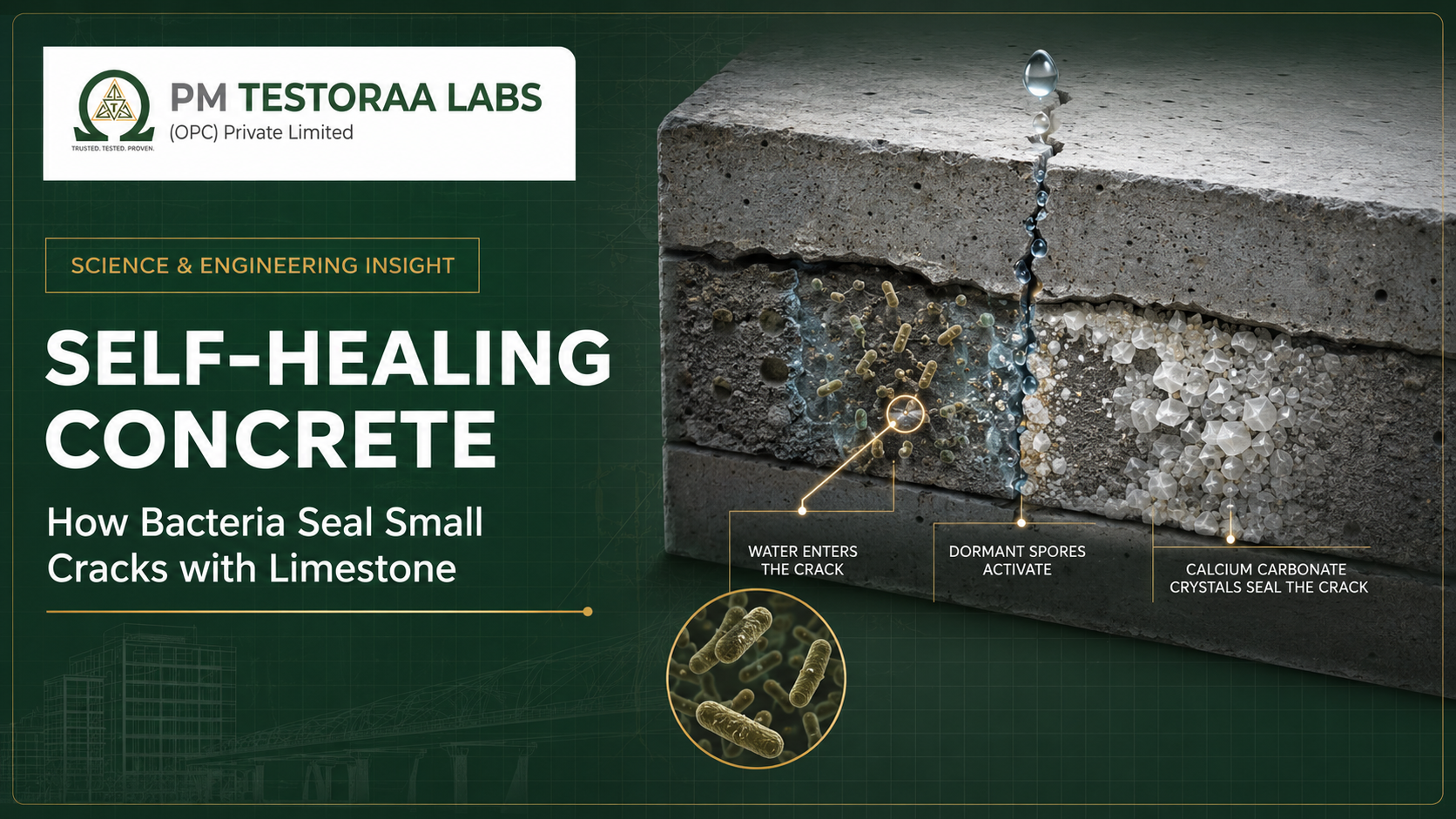
A small crack forms
Water enters the crack
Dormant spores activate
Metabolism promotes CaCO₃
Mineral seals the pathway
Step 1: water reaches the healing agent
A crack opens through or near the protected particles. Water entering the crack dissolves or transports nutrients and creates the condition needed for bacterial activity. This is one reason exposure matters: a permanently dry interior crack may not activate the same way as a periodically wet crack.
Step 2: spores become metabolically active
The bacteria use the available organic precursor under suitable oxygen, moisture and temperature conditions. In the Delft concept, calcium lactate has been used as part of a two-component healing agent. The biological reactions produce carbonate species in an alkaline environment containing calcium.
Step 3: calcium carbonate precipitates
Calcium ions combine with carbonate to form solid calcium carbonate. Crystals nucleate on surfaces and bacterial cell walls, then grow within the crack. Ordinary ongoing hydration and non-biological carbonate precipitation can contribute at the same time. The final seal is therefore a combined biological and cementitious process rather than a tiny organism “building a wall” by itself.
Calcium source + microbial carbonate formation → calcium carbonate (CaCO₃) deposited in the crack
Step 4: the pathway becomes less permeable
As mineral accumulates, the visible crack width reduces and water flow may fall substantially. Less water and oxygen reach the reinforcement. In some metabolic pathways, oxygen consumption can also locally support corrosion protection, although this should not be treated as a substitute for adequate concrete cover, low permeability and correct material design.
Step 5: activity slows after sealing
When water or nutrients are no longer available, activity reduces and remaining spores may return to dormancy. Whether the system can heal a later crack depends on surviving spores, remaining nutrient, location of the new crack and the delivery technology. “Repeatable healing for decades” must be demonstrated for the specific formulation; it should not be assumed from a short laboratory test.
Plain-language picture: The concrete contains protected biological “repair kits.” A small wet crack opens one of those kits. The bacteria help create limestone-like crystals, which plug the leak. The kit works only where the crack, water, bacteria, nutrient and suitable environment meet.
Not all self-healing concrete is bacterial
Self-healing concrete is a broad family of technologies. A news headline may use the term as though it refers to one material, but different systems use different mechanisms and have different design, cost and testing requirements.
| Approach | Healing mechanism | Main engineering consideration |
|---|---|---|
| Autogenous healing | Continued cement hydration and natural calcium-carbonate precipitation | Most effective for very fine, stable cracks with moisture; limited and variable. |
| Bacteria-based healing | Microbial activity promotes calcium-carbonate deposition | Spore survival, nutrient delivery, encapsulation, moisture and crack width control. |
| Crystalline admixtures | Reactive chemicals form insoluble products when water enters | Compatibility, water pressure, crack size and verified system performance. |
| Microcapsule systems | A crack ruptures capsules containing polymeric or mineral healing agent | Capsule distribution, one-time release, bond and material-property effects. |
| Vascular networks | Internal channels deliver a healing liquid to damaged areas | Complex manufacture, refill strategy, channels and structural integration. |
| Shape-memory or expansive systems | Materials close cracks mechanically or through controlled expansion | Activation, restraint, long-term stability and residual stress. |
These approaches can be combined, but performance claims cannot be transferred from one system to another. “Self-healing” should be followed by the actual mechanism, tested crack range, exposure condition, number of healing cycles and acceptance criteria.
What the research evidence actually shows
Professor Jonkers and collaborators began publishing bacteria-based concrete concepts in the late 2000s. A 2010 paper in Ecological Engineering investigated bacteria as a self-healing agent for sustainable concrete. A widely cited 2011 study by Virginie Wiktor and Henk Jonkers quantified crack healing in a two-component biochemical system embedded in porous particles.
That research compared bacteria-based specimens with control concrete and showed substantially greater crack closure in the treated material. TU Delft summaries reported healing of cracks up to about 0.5 mm in the bacteria-based system, whereas natural healing in controls was limited to smaller widths. Later research and demonstrator publications described sealing of cracks up to about 0.8 mm for particular formulations and conditions, with improved watertightness and resistance to frost-related damage.
Correct way to use these numbers: “Research has demonstrated enhanced sealing of sub-millimetre cracks under specified conditions.” Incorrect way: “All bacterial concrete automatically repairs every crack up to 1 mm.”
Crack-width closure is only one outcome. Researchers also measure water permeability, sorptivity, chloride ingress, freeze–thaw response, visual mineral coverage, crystal composition and recovery of mechanical properties. A crack may look closed at the surface while remaining partly open internally. Conversely, a mineral layer that is not perfectly smooth may still reduce water flow.
From laboratory specimens to demonstrators
European research programmes have supported full-scale demonstrator projects and common test methods for self-healing concrete. Demonstrators are important because real structures have variable cracks, construction tolerances, weather, reinforcement, restraint and sustained loads. Field exposure also tests whether healing products remain bonded through wetting, drying, temperature change and continued movement.
The published field history is still much shorter than the intended design life of major concrete infrastructure. A building, bridge or tunnel may be designed for many decades. Long-term claims therefore require monitoring, not only accelerated laboratory evidence. Commercial products may already exist for specialised applications, but widespread mainstream adoption depends on cost, specification, reliable quality control, approval and proof of service-life benefit.
Research is promising, not permission to ignore crack control
The technology is best viewed as a durability-resilience layer. Structural design must still control stresses and crack widths, provide adequate reinforcement, cover and joints, and account for exposure. If cracking exceeds the tested capacity or continues to move, the agent may not form a stable seal. Designing a member to crack excessively because “the bacteria will repair it” reverses the intended logic.
What does “healed” mean to an engineer?
The word can refer to different levels of recovery. A report must state which level was measured. Without that definition, two studies may both claim “90% healing” while measuring completely different things.
Visual closureSurface observation
The visible crack width is reduced by deposited material. This is easy to show but does not prove internal continuity.
Watertightness recoveryDurability function
Water flow or permeability through the cracked specimen is reduced. Often the most valuable practical outcome.
Mechanical recoveryStructural response
Stiffness, tensile capacity, flexural strength or fracture resistance is partly restored. This is harder to achieve and verify.
Bacterial systems are especially promising for visual sealing and recovery of liquid tightness. They may improve some mechanical properties locally, but a calcium-carbonate fill should not automatically be assumed to recreate the monolithic tensile behaviour of uncracked concrete. Reinforcement that has yielded, fractured or corroded is not repaired by mineral precipitation.
A leak can stop while the cause remains
Imagine a basement wall with a fine, stable shrinkage crack. Mineral deposition may close the water path and provide a meaningful serviceability benefit. Now imagine a diagonal crack caused by ongoing foundation settlement. The bacteria may deposit mineral during a wet period, but further movement can reopen the crack. The foundation problem remains.
Similarly, a flexural crack in a correctly designed member may open and close with load. Healing effectiveness depends on the sustained crack width during treatment and subsequent movement. A structure subject to vibration, thermal cycling or joint movement needs a system validated for that behaviour.
Never equate surface closure with structural certification. Safety evaluation requires the crack pattern, width, depth, movement, load path, reinforcement, material condition and cause—not merely a photograph of white mineral growth.
How self-healing concrete should be tested
A test programme begins by defining the performance objective. Is the goal to stop leakage, reduce chloride ingress, close a visible crack, preserve reinforcement, recover stiffness or extend service life? The specimen, crack method, exposure and measurement must represent that objective.
| Test stage | Evidence to collect | Why it matters |
|---|---|---|
| Healing-agent qualification | Bacterial identity, spore count or activity, carrier properties, nutrient dosage, storage stability and safety information | Confirms that the biological component delivered to site matches the evaluated system. |
| Fresh concrete | Workability, density, air content, temperature, setting and compatibility with admixtures | The carrier or nutrient may affect rheology, setting and placement. |
| Baseline hardened concrete | Compressive strength, tensile/flexural response, permeability, shrinkage and durability indicators | Healing additions must not create unacceptable loss in normal concrete performance. |
| Controlled cracking | Age, loading method, crack width, depth, orientation and whether reinforcement is present | Healing performance depends strongly on the way the crack was created. |
| Healing exposure | Water regime, temperature, duration, oxygen, wet–dry cycles and chemical environment | Laboratory immersion can overestimate performance for dry field exposure. |
| Visual closure | Calibrated microscopy or image analysis at marked locations and intervals | Quantifies surface change without relying on impression. |
| Water transport | Permeability, flow, sorptivity or leakage under relevant pressure | Shows whether the durability function has recovered. |
| Mechanical response | Reloading, stiffness, strength, bond or fracture testing where required | Separates watertightness recovery from structural recovery. |
| Mineral confirmation | Microscopy, X-ray diffraction, spectroscopy or chemical analysis in research/qualification | Confirms the nature and distribution of deposited material. |
| Long-term cycling | Recracking, repeated wet–dry exposure, thermal cycles and durability monitoring | Tests stability and any capacity for repeat healing. |
Use realistic crack conditions
A laboratory crack created at a chosen age and immediately submerged in water is useful for comparison, but it may not represent a sun-exposed slab or cyclic bridge crack. Qualification should include the expected field moisture, temperature, chemical exposure and time between cracking and wetting. Chloride water, seawater, acidic exposure or high water pressure may change both bacterial activity and mineral stability.
Controls are essential
Parallel control specimens without the bacterial agent show the autogenous healing of the base concrete. Without controls, natural mineral precipitation may be wrongly credited to bacteria. Replicate specimens and statistical reporting are needed because crack geometry and agent distribution vary.
Sampling direction and internal condition matter
Surface microscopy can exaggerate internal closure if crystals form mainly near the exposed face. Sections, cores, tomography or complementary transport tests may be needed. For reinforced members, tests should consider whether the crack reaches steel and whether the healing system influences bond or corrosion.
Laboratory reporting principle: Record the base mix, healing agent, dosage, carrier, crack creation method, initial crack width, exposure, measurement technique, age and uncertainty. A single “percentage healed” without these details is not transferable to another project.
Where bacteria-based concrete could add value
The strongest business case occurs where small leaks or durability damage are expensive to access, interrupt or repair. The technology is not necessarily intended for every column and slab.
Water-retaining structuresReservoirs, tanks and treatment units can benefit if qualified crack sealing reduces leakage and reinforcement exposure.
Tunnels and basementsExternal waterproofing may be inaccessible after construction, making autonomous sealing attractive.
Marine and coastal worksEarly sealing could reduce chloride entry, but the system must be validated for seawater and wet–dry exposure.
Bridge decks and parking structuresReduced water and salt ingress may slow corrosion where stable service cracks are the main pathway.
Precast componentsFactory production offers tighter control of dosage, curing, geometry and quality records.
Remote or critical assetsStructures with difficult access may justify higher initial cost if lifecycle performance is demonstrated.
A value analysis should compare initial material premium with inspection, access, shutdown, repair, traffic management, waterproofing and residual service life. A claim of “billions saved” may be plausible at global infrastructure scale, but an individual project needs a transparent lifecycle-cost model.
Potential carbon benefit
Repair and replacement consume cement, aggregates, steel, transport and energy. If self-healing reliably extends service life, avoided interventions can reduce lifecycle emissions. Yet the base mix and healing-agent production also have impacts. Some bacterial systems require carriers and nutrients; performance may be achieved with additional binder or processing. A life-cycle assessment must compare equivalent function and service life, not only kilograms of material at initial construction.
Use selective placement
Researchers and designers are exploring healing agents in cover zones, joints or locations with high leakage risk rather than dosing the entire member uniformly. Targeted use can reduce cost and concentrate protection where it provides the greatest benefit. It also requires controlled placement and verification so the intended zone actually contains the healing system.
Limitations every owner and engineer should understand
- Crack-width capacity is limited. Published sub-millimetre results do not apply to large, open or displaced cracks.
- Movement can defeat the seal. Settlement, thermal cycling, fatigue or overload can reopen deposited mineral.
- Water is usually needed for activation. Dry exposure may provide little healing, while continuous aggressive water may present other durability challenges.
- Distribution is not perfectly uniform. A crack must intersect enough viable agent and nutrient.
- Long-term viability is formulation-dependent. Encapsulation improves protection, but decades-long performance must be supported by ageing and field data.
- Structural recovery may be limited. Watertightness is more readily demonstrated than complete tensile or load-bearing recovery.
- Base concrete properties can change. Carriers and nutrients may affect workability, strength, porosity, shrinkage or cost.
- Healing may be one-time or finite. Nutrient and spores can be consumed locally; repeated-crack capacity must be tested.
- Quality control is specialised. Biological activity, carrier storage and batch consistency add controls beyond ordinary concrete production.
- Standardisation is still evolving. Specifications, acceptance tests and regulatory pathways are less mature than for conventional concrete.
Biological and environmental safety
Research generally uses non-pathogenic, naturally occurring or selected spore-forming bacteria suited to alkaline environments. Nevertheless, a product should have documented strain identification, biosafety status, handling guidance and environmental evaluation. “Natural” does not remove the need for responsible material approval.
Cost cannot be separated from risk
A higher material cost may be reasonable for an inaccessible tunnel but uneconomic for an easily repaired pavement. Cost models should use probability of cracking, repair method, access cost, downtime, consequence of leakage, monitoring and residual value. Optimistic assumptions about perfect healing can produce misleading savings.
What this means for Indian construction practice
India has enormous exposure to heat, monsoon wetting, coastal chlorides, industrial environments, variable workmanship and rapid infrastructure growth. A material that autonomously seals fine cracks could support durability, but local validation is essential. European laboratory results cannot be copied directly into every Indian climate, cement system, aggregate source and curing practice.
Indian structural design and concrete production remain governed by the applicable legal framework, National Building Construction Standards, project specifications and relevant Indian Standards. IS 456 principles for durability, cover, materials, workmanship, curing and crack control still apply. Mix proportioning, material testing and strength verification continue through applicable standards such as IS 10262 and the IS 516 series. A novel healing agent does not replace these requirements.
Current professional approach: treat bacteria-based self-healing concrete as a performance-engineered addition. Obtain authority and client acceptance, establish a project specification, run laboratory trials with local materials, execute a representative field trial, define acceptance criteria and monitor the completed work.
A practical approval pathway
Define the durability problem. Identify exposure, expected crack mechanism, target crack width, leakage pressure and required service life.
Select a documented system. Review bacterial strain, carrier, nutrient, dosage, safety, storage and published performance.
Test with local concrete materials. Confirm fresh properties, strength, shrinkage, permeability and healing under representative conditions.
Agree performance criteria. State crack range, healing time, exposure, watertightness recovery, mechanical requirements and test methods.
Construct a trial panel or component. Use actual batching, transport, placement, curing, reinforcement and quality-control procedures.
Monitor and document. Track cracks, leakage, corrosion indicators and durability; compare against conventional control areas where possible.
Do not add bacteria casually at site
Self-healing concrete is not made by pouring an arbitrary bacterial culture into a ready-mix truck. The cement environment, mix water, admixtures, carrier strength, nutrient chemistry and dosage must be engineered. Uncontrolled addition can harm workability, setting, strength and durability while providing no reliable healing.
Procurement should specify a complete evaluated product or process, not merely “bacterial concrete.” Responsibilities for design, material supply, batching, testing and acceptance must be clear. Proprietary claims should be supported by test reports relevant to the intended exposure and concrete system.
Inspection and NDT after self-healing
Existing inspection methods remain important, but results need careful interpretation. Crack microscopy or gauges can track surface width and movement. Water tests can measure leakage or permeability recovery. Half-cell potential and resistivity can help assess reinforcement-corrosion risk under suitable conditions. UPV may provide comparative information about concrete continuity, while rebound hammer remains a surface-hardness indicator.
None of these instruments alone proves successful biological healing. Mineral deposits can alter a surface reading without restoring internal mechanical continuity. Reinforcement scanning identifies bar location and cover, not bacterial viability. Cores may reveal internal crack filling but are local and destructive. A sound assessment combines the original design, crack cause, exposure, material records, controlled measurements and structural analysis.
| Question | Useful evidence | What it cannot prove alone |
|---|---|---|
| Has the visible crack closed? | Calibrated photography, microscopy and fixed crack gauges | Internal closure, strength recovery or future stability |
| Has leakage reduced? | Controlled water-pressure or flow testing | Structural adequacy or reinforcement condition |
| Is corrosion risk reducing? | Exposure data, half-cell mapping, resistivity and chloride/carbonation assessment | Actual steel section loss without further investigation |
| Is the crack still active? | Tell-tales, displacement gauges or long-term monitoring | The root cause unless supported by engineering assessment |
| Is the member structurally safe? | Condition survey, design review, tests and structural analysis | No single surface test provides this conclusion |
“Self-healing concrete should reduce the opportunity for deterioration—not reduce the engineer’s responsibility to understand why the concrete cracked.”PM Testoraa Labs engineering perspective
Myths and engineering reality
| Myth | Engineering reality |
|---|---|
| “The bacteria repair an entire cracked building.” | They can help seal small cracks in an engineered material system. Building safety depends on the crack cause, structure and reinforcement. |
| “All cracks up to 1 mm will heal.” | Published performance varies by formulation and conditions. Project-specific test evidence is required. |
| “The concrete becomes alive.” | Protected spores remain dormant and become active under suitable moisture and nutrient conditions; concrete is not a living organism. |
| “A closed crack has regained full strength.” | Visual and watertightness recovery do not automatically mean complete mechanical recovery. |
| “Bacterial concrete needs no waterproofing or maintenance.” | It may complement a durability system; joints, membranes, drainage, inspections and maintenance may still be required. |
| “It is automatically sustainable.” | Lifecycle benefit depends on avoided repair, service-life extension, agent production, base mix and verified performance. |
| “Any bacteria can be mixed into concrete.” | Strain, spores, carrier, nutrient, dosage, safety and compatibility require specialised design and qualification. |
| “Self-healing allows wider design cracks.” | Code-compliant crack control remains essential unless a formally approved performance-based design demonstrates otherwise. |
Frequently asked questions
Who developed bacteria-based self-healing concrete?
Professor Henk Jonkers and colleagues at Delft University of Technology are widely recognised for pioneering influential bacteria-based self-healing concrete research from the late 2000s onward. Many research teams and companies have since developed related systems.
Do bacteria remain active inside concrete all the time?
No. They are generally introduced as dormant spores protected in a carrier. Suitable water and nutrients are needed for activation. Activity reduces when the crack seals or conditions are no longer favourable.
What material fills the crack?
The main healing product discussed in the Delft work is calcium carbonate, a mineral associated with limestone. Continued cement hydration and natural carbonate precipitation may also contribute.
How wide a crack can bacterial concrete heal?
Research has reported enhanced sealing of sub-millimetre cracks, including about 0.5 mm in early work and up to about 0.8 mm in later specified systems. These are not universal limits; performance depends on the product and conditions.
Can it repair a structural crack?
It may seal a small water pathway, but it does not automatically restore structural capacity or repair reinforcement. Structural cracks require diagnosis and, where necessary, engineered repair or strengthening.
Does the concrete heal without water?
Most bacteria-based concepts depend on water entering the crack to activate spores and transport nutrients. Healing in dry exposure may be limited unless the system provides another activation route.
Is it already available commercially?
Specialised self-healing products and pilot applications exist, but mainstream adoption remains limited compared with conventional concrete. Availability, evidence, cost and approval vary by region and product.
Can it prevent reinforcement corrosion?
By reducing crack permeability, it can potentially slow the entry of water, oxygen and chlorides. It cannot replace adequate cover, low-permeability concrete, crack control or treatment of existing advanced corrosion.
How should an Indian project adopt it?
Use a documented system, obtain approvals, validate with local materials and exposure, specify measurable performance, conduct trial construction and monitor field results. Do not use uncontrolled site additions.
Why PM Testoraa Labs?
PM TESTORAA LABS (OPC) Private Limited supports evidence-based concrete quality and infrastructure-durability decisions. Our capabilities include rebound-hammer and ultrasonic pulse velocity testing, crack mapping, reinforcement scanning, half-cell corrosion-potential assessment, carbonation testing, concrete core testing, material testing, structural audits, geotechnical investigation and forensic engineering documentation.
For an emerging material, testing must be planned around the claimed performance. Testoraa Labs can support project-specific baseline characterisation, crack and condition documentation, conventional concrete testing and monitoring within the scope of applicable methods, while clearly stating limitations and the need for competent structural interpretation.
Concerned about cracks, leakage or reinforcement corrosion?
Start by identifying the cause and condition. The right investigation prevents cosmetic crack filling from hiding a developing structural or durability problem.
References
- Times of India Science Desk, “Dutch scientist created bacteria that repair cracked buildings…,” 27 July 2026.
- Jonkers, H.M., Thijssen, A., Muyzer, G., Çopuroğlu, O. and Schlangen, E., “Application of bacteria as self-healing agent for the development of sustainable concrete,”Ecological Engineering, 2010.
- Wiktor, V.A.C. and Jonkers, H.M., “Quantification of crack-healing in novel bacteria-based self-healing concrete,”Cement and Concrete Composites, 33(7), 2011, 763–770.
- Jonkers, H.M., “Bacteria-based self-healing concrete,”HERON, 56(1/2), 2011.
- Jonkers, H.M., “Self-healing of cracks in concrete via bacterial aerobic metabolism,” TU Delft research output, 2016.
- European Commission CORDIS, Self-healing concrete to create durable and sustainable concrete structures, project results.
- Government of India/Bureau of Indian Standards, applicable current editions and amendments of IS 456, IS 10262 and the IS 516 series, together with project-specific material, durability and structural requirements.
Technical disclaimer: This article is an independent educational interpretation of publicly available information accessed up to 28 July 2026. It does not endorse a proprietary bacterial product and is not a structural safety certificate, repair specification or substitute for the official standards and project-specific engineering assessment. Published healing widths and outcomes depend on formulation, crack condition, exposure and test method. Cracks associated with movement, overload, corrosion, fire, impact, settlement or other distress require professional investigation before repair or continued occupancy decisions.