

Waste Valorisation · Geopolymer Technology · Fire Engineering
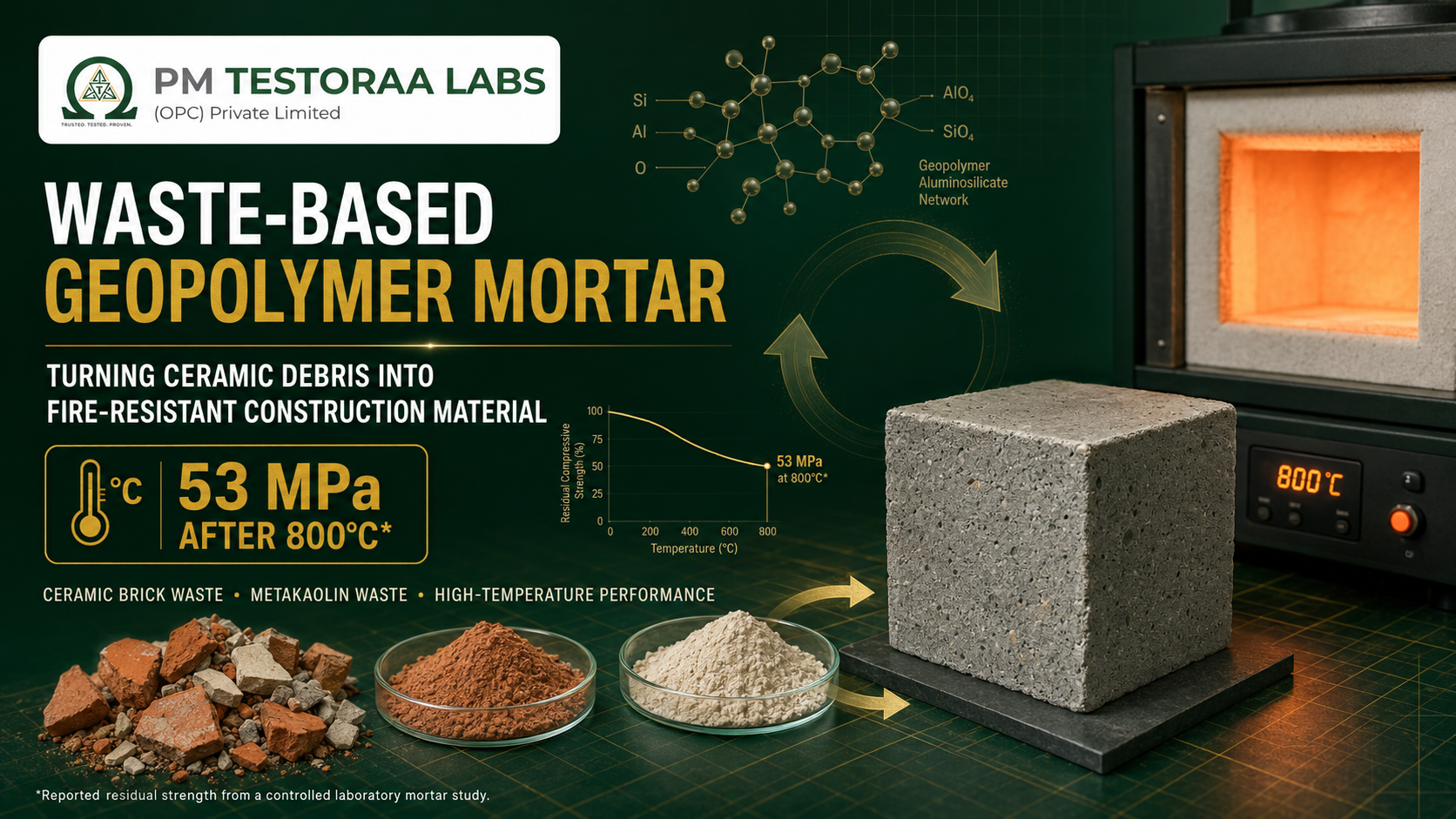
Waste-Based Geopolymer Mortar: Turning Ceramic Debris into Fire-Resistant Construction Material
What a 2026 study really discovered about ceramic-brick and metakaolin waste, why the aggregate controls behaviour at high temperature, and what engineers must verify before using the material in a building.
The quick answer
Researchers at Kaunas University of Technology in Lithuania have developed alkali-activated mortar in which the powder used to make the binder came entirely from two waste streams: crushed ceramic-brick waste and metakaolin waste. When the most promising binder was combined with heat-stable fine aggregate, it retained useful compressive strength after exposure to temperatures as high as 800°C.
The headline result was obtained with a binder containing 75% ceramic-brick waste and 25% metakaolin waste. After specimens were heated to 800°C, held for two hours, cooled and then tested, mortar made with ceramic-waste aggregate reached 34.7 MPa, or 78.7% of its original room-temperature strength. Mortar made with corundum aggregate reached 53.0 MPa, equivalent to 108.6% of its initial strength.
In common language: carefully selected waste powders can react to form a hard mineral binder, and the right sand-like aggregate can help that mortar survive extreme heat. The result is scientifically promising for protective linings, industrial zones and fire-exposed construction—but it is not yet proof that a complete column, slab or tunnel lining has a certified fire-resistance rating.
The research also produced an important warning. Ordinary river sand, granite and basalt did not perform as well at the highest temperature. The binder chemistry mattered, but the type of fine aggregate and its thermal compatibility with the surrounding matrix strongly influenced cracking, mass loss and residual strength.
What did the 2026 research report?
The study, published in Scientific Reports on 25 May 2026, is titled “Influence of fine aggregate type on geopolymer mortar performance in an elevated temperature environment.” It was carried out by Martynas Statkauskas, Danutė Vaičiukynienė and Audrius Grinys of Kaunas University of Technology. A university news report, later covered by Tech Xplore on 28 July 2026, presented the material as a greener, fire-resistant alternative to conventional cement mortar.
The scientific question was precise: if the binder is made from ceramic-brick waste and metakaolin waste, which fine aggregate enables the mortar to retain the most strength after high-temperature exposure?
Waste binder precursorsDemolition-derived ceramic bricks were milled into powder. Metakaolin waste came from a Lithuanian expanded-glass manufacturing process.
Five aggregate optionsThe researchers compared ordinary river sand, granite, basalt, ceramic waste and corundum, all in the 0–3 mm size range.
Four heat levelsHardened specimens were heated to 200°C, 400°C, 600°C and 800°C so that progressive thermal damage could be measured.
Performance after coolingDensity, mass loss, cracking and compressive strength were evaluated after the hot specimens cooled naturally in the furnace.
The work is valuable because many studies optimise geopolymer chemistry at ordinary temperature but pay less attention to the aggregate. In a fire, the paste and aggregate expand, shrink, dehydrate and transform differently. A high-strength binder can still crack badly if its aggregate undergoes a sudden mineral change or expands at a different rate.
Read the news headline carefully: the published experiment used mortar specimens exposed once to a controlled furnace temperature. It did not report a building-scale fire test or establish that the material becomes stronger after repeated fires. Claims about repeated exposure should be treated as a future research direction unless verified by separate cyclic-heating evidence.
What is geopolymer mortar?
Conventional mortar normally uses Portland cement as the binder. When water is added, the cement hydrates and produces calcium-rich compounds that glue the sand particles together. A geopolymer or alkali-activated mortar takes a different chemical route. It uses a powder rich in reactive silica and alumina, together with an alkaline activating solution, to build a hardened three-dimensional mineral network.
The term “geopolymer” covers several chemistries, so it should not be treated as one universal product. In this study, the reactive powders were ceramic-brick waste and metakaolin waste. The activating solution contained 8 molar sodium hydroxide and sodium silicate, with a sodium-silicate-to-sodium-hydroxide ratio of 1.5.
Waste bricks and metakaolin
Drying, crushing and milling
Alkaline activation
Mixing with fine aggregate
Hard mineral matrix
Why ceramic brick waste can react
Clay bricks are fired during manufacture. The heat changes the clay minerals and can leave aluminosilicate phases that are capable of dissolving in a sufficiently alkaline solution, particularly after the brick is finely ground. Silicon- and aluminium-bearing species are released, reorganise and form binding gels. The exact reaction depends on the original clay, firing history, particle size, activator and curing conditions.
Why add metakaolin waste?
Metakaolin is produced by heating kaolin clay so that it becomes highly reactive. Metakaolin waste can therefore supply readily available alumina and silica, helping strength development. Yet “more reactive” is not automatically “better at every temperature.” In the study, mixtures rich in metakaolin waste often developed high initial strength but needed more activator and water and experienced greater mass and strength loss at 800°C.
The binder and aggregate have different jobs
PrecursorThe waste powder supplies reactive silicon and aluminium.
ActivatorSodium hydroxide and sodium silicate dissolve and reconnect the reactive species.
Fine aggregateThe sand-sized skeleton controls volume stability, thermal mismatch and crack paths.
This distinction explains why two mortars made with the same binder can behave very differently in a furnace. The aggregate is not an inert filler at high temperature; its mineralogy and thermal expansion become part of the performance system.
How the experiment was conducted
The researchers produced five binder compositions, labelled F1 to F5, by gradually replacing ceramic-brick waste with metakaolin waste. F1 contained ceramic-brick waste only; F5 contained metakaolin waste only. Between them were blends, including the 75:25 ceramic-brick-waste-to-metakaolin-waste mixture identified as F2.
Each binder was mixed separately with five fine aggregates: ordinary river sand, crushed granite, basalt, ceramic waste and corundum. The fine aggregate was 0–3 mm and the aggregate-to-precursor mass ratio was 1.5. This produced a matrix of mixes that allowed the researchers to separate the influence of binder composition, aggregate mineralogy and exposure temperature.
| Study variable | Tested condition | Why it matters |
|---|---|---|
| Binder precursors | Ceramic-brick waste and metakaolin waste, blended from 100:0 to 0:100 | Changes reactivity, gel composition, water demand and thermal stability. |
| Alkaline activator | 8 M NaOH plus sodium silicate; Na₂SiO₃/NaOH ratio 1.5 | Controls dissolution and geopolymerisation; also affects safety and embodied impact. |
| Fine aggregate | River sand, granite, basalt, ceramic waste and corundum | Controls thermal expansion, phase change, strength and crack development. |
| Aggregate size | 0–3 mm | Confirms the product tested was mortar, not coarse-aggregate concrete. |
| Heating rate | 5°C per minute | A controlled rate limits thermal shock and makes mixes comparable. |
| Target temperatures | 200°C, 400°C, 600°C and 800°C | Captures drying, dehydration, mineral transformation and high-temperature sintering. |
| Exposure at target | Two-hour hold | Allows temperature-related changes to develop through the specimen. |
| Post-heating condition | Natural furnace cooling; evaluation after 24 hours | Results describe residual properties after cooling, not capacity while hot. |
Heating at 5°C per minute to a uniform target, holding for two hours and cooling in the furnace is a sensible laboratory comparison method. However, a real fire can heat much faster, create steep temperature gradients and cool suddenly through firefighting water. Structural members also carry load, are restrained by adjacent members and may contain reinforcement. These differences are central when moving from material research to building design.
What were the key results?
The strongest high-temperature result came from the F2 binder containing 75% ceramic-brick waste and 25% metakaolin waste. With corundum fine aggregate, the residual compressive strength after 800°C was 53.0 MPa—108.6% of the room-temperature value. With ceramic-waste aggregate, it was 34.7 MPa—78.7% of the original value.
| Fine aggregate | General room-temperature performance | Behaviour at 800°C | Engineering interpretation |
|---|---|---|---|
| Corundum | High strength; average about 49.0 MPa across binders | Highest average residual strength, about 33.6 MPa; F2 reached 53.0 MPa | Excellent thermal stability and compatibility; technically strongest but likely the premium option. |
| Ceramic waste | Moderate average strength, about 43.8 MPa | Average about 20.3 MPa; F2 reached 34.7 MPa | Promising circular solution with good residual performance and reduced surface cracking. |
| Basalt | Highest average initial strength, about 52.7 MPa | Average fell to about 18.0 MPa | Useful at moderate temperatures, but severe exposure caused significant loss. |
| Granite | Average initial strength about 47.9 MPa | Average fell to about 15.2 MPa | Thermal mismatch and mineral transformations reduced high-temperature reliability. |
| Ordinary river sand | Familiar construction aggregate | Among the least suitable at high temperature | Quartz-rich sand can expand sharply near 573°C and promote cracking. |
These averages combine several binder compositions, so they should not be used as design values. Their purpose is to show the trend: corundum was the most robust aggregate, ceramic waste offered a strong circular alternative, and ordinary quartz-rich sand was the least favourable for severe temperature exposure.
Why could strength increase after 800°C?
At first this seems impossible. Heat normally damages cementitious material by evaporating water, dehydrating binding phases and creating cracks. In a well-matched geopolymer system, however, high temperature can also promote additional condensation and sintering. Particles and partially reacted phases fuse more tightly, pores close and the matrix becomes denser. If thermal expansion is compatible and cracking remains limited, this densification can outweigh the damage in a small specimen.
The F2-corundum mortar appears to have benefited from that balance. The paper reports a density of about 2,164 kg/m³ after 800°C and mass loss of about 4.0%, alongside the 53.0 MPa residual strength. By contrast, metakaolin-rich F5 mixtures generally experienced larger mass losses—approximately 7.9% to 11.4%—and much lower strengths at the highest temperature.
Important: a strength increase after controlled heating does not mean engineers should “heat-treat” a building, expect every geopolymer to improve in fire, or return a fire-damaged member to service without investigation. The result belongs to a specific mortar, specimen geometry, heating history and test method.
Why the aggregate controls high-temperature behaviour
At normal temperature, engineers often focus on binder strength and treat fine aggregate mainly as a clean, well-graded filler. At elevated temperature, aggregate mineralogy becomes critical. Each mineral expands at its own rate, may change crystal form and may lose or retain stiffness differently from the binder around it.
Quartz-rich river sand
Many natural sands contain substantial quartz. At approximately 573°C, quartz undergoes a reversible crystal transformation from alpha quartz to beta quartz. The transformation creates a sudden volume change. In a mortar specimen, the surrounding matrix may not expand in the same way, so stress develops around the aggregate-paste interface. Microcracks connect, stiffness decreases and compressive strength falls.
Granite and basalt
Granite contains several minerals, commonly including quartz and feldspar, each with different thermal properties. Basalt is generally stronger and may be more stable than quartz-rich sand at moderate temperature, but it is still not immune to differential expansion, oxidation of some constituents or thermal microcracking. The study found reasonable performance up to intermediate temperatures, followed by substantial loss at 800°C.
Ceramic-waste aggregate
Crushed ceramic material has already experienced high temperature during brick manufacture. It may therefore offer better dimensional compatibility with a ceramic-derived geopolymer matrix. Its porous surface can also create mechanical interlock. In this study it produced good strength retention and limited surface cracking, while adding a second route for demolition waste to re-enter construction.
Corundum
Corundum is crystalline aluminium oxide. It is a hard refractory mineral with a melting point and service-temperature capability far beyond the temperatures of ordinary building fires. It remained stable while the binder densified, which helped the mortar retain or gain strength. Its disadvantages are practical: refractory-grade aggregate may be more expensive, heavier to process and more energy intensive than locally recovered ceramic waste.
A fire-resistant binder and an ordinary aggregate do not automatically make a fire-resistant mortar. The two materials must move, transform and transfer heat compatibly.Core engineering lesson
Residual strength is not a structural fire rating
This is the most important distinction in the entire story. The study measured compressive strength after small specimens had been heated, held, cooled and stored for 24 hours. That is called residual strength. It is useful for screening materials and understanding damage, but it is not the same as the fire resistance of a wall, slab, beam, column or tunnel segment.
A structural fire-resistance test evaluates a full assembly or representative member while it is exposed to a prescribed time-temperature curve. Depending on the requirement, the test examines load-bearing capacity, integrity against flames and hot gases, and insulation against temperature rise. The member may be loaded and restrained; deformation and spalling are monitored over time.
| Question | 2026 mortar study | Structural fire-resistance evaluation |
|---|---|---|
| What is tested? | Small mortar specimens with 0–3 mm fine aggregate | Representative wall, floor, beam, column, lining or protection system |
| When is strength checked? | After heating and cooling | Capacity and failure criteria are monitored during fire exposure |
| Structural load? | No member-scale applied design load | Load may be applied to represent service conditions |
| Reinforcement? | No reinforced-concrete member | Steel temperature, cover, bond and restraint are central |
| Output | Residual MPa, mass loss, density and cracking | Fire-resistance duration and applicable performance classification |
| Can it approve a building system? | No; it supports research and material selection | It can support approval within the tested scope and applicable standard |
Concrete and mortar do not need to ignite to fail. Heat can reduce stiffness and strength, drive vapour pressure, cause explosive spalling and expose reinforcement. Steel loses strength rapidly as its temperature rises. A material with excellent post-heating cube strength could still perform poorly as a thin, restrained or heavily loaded member if it transfers heat quickly or spalls.
For design and approval: do not convert “53 MPa after 800°C” into a 60-, 120- or 180-minute fire rating. A rating requires a relevant standard test or a validated engineering assessment covering the actual system, thickness, load, joints, restraint, moisture and construction details.
Is the mortar truly greener?
The material has a strong circular-economy logic. Demolished bricks and a metakaolin-rich industrial residue are used as binder precursors rather than landfilled. Alkali activation can avoid Portland-clinker production, including the limestone calcination and very high kiln temperatures that make conventional cement carbon intensive.
But the research paper was a performance study, not a full Life Cycle Assessment. It did not publish an Environmental Product Declaration or a verified carbon footprint for one tonne of the mortar. “Greener” is therefore a credible direction, not a complete quantified conclusion.
Potential environmental gainsWaste diversion, avoided virgin raw material, reduced Portland clinker, local demolition-waste loops and possibly longer service in severe thermal environments.
Impacts that remainWaste sorting, drying, crushing, fine grinding, transport, mixing, curing and manufacture of sodium hydroxide and sodium silicate.
Corundum trade-offIt produced the best heat performance, but manufactured refractory aggregate may have higher cost and embodied energy than recycled ceramic aggregate.
Service-life valueA lining that lasts longer and avoids replacement can save more lifecycle carbon than a low-impact material that deteriorates early.
“Made from waste” needs a boundary
The binder powders in the study were waste-derived. The complete mortar was not necessarily 100% waste. The activator was manufactured chemical material, and corundum aggregate is generally not a demolition waste. A transparent product claim should state whether it refers to the binder precursor, total binder, total dry solids or complete mortar.
What a proper environmental comparison should include
- collection and sorting of demolished ceramic material;
- transport distances and moisture content;
- energy required for crushing and fine grinding;
- production of sodium hydroxide and sodium silicate;
- aggregate extraction or recycling, especially the corundum-versus-ceramic choice;
- curing energy, yield and production waste;
- equivalent strength, durability, thickness and service life;
- repair frequency and end-of-life recovery.
The fairest comparison is not one kilogram of geopolymer against one kilogram of cement. It is the quantity of each material required to deliver the same structural or protective function for the same service life.
Where could this material be useful?
The researchers suggest applications in environments where heat resistance and resource efficiency are both valuable. The most realistic early uses may be non-primary or protection-focused applications, because they can be qualified without immediately redesigning an entire structural system.
Tunnel and service liningsHeat-stable repair mortar or protective layers could help slow damage and protect the substrate, subject to bond, spalling and fire-system testing.
Industrial floors and plinthsZones near furnaces, boilers, foundries and process equipment may benefit from thermal stability and abrasion-resistant aggregate.
Chimneys and incineratorsProtective linings could utilise refractory aggregate, provided chemical attack, thermal cycling and differential movement are verified.
Precast thermal barriersFactory-controlled panels or blocks allow repeatable batching, curing, inspection and testing before site installation.
Fire-damaged repair zonesA compatible repair material may protect an existing substrate, but bond, shrinkage, vapour transport and residual substrate strength control success.
Circular masonry productsCeramic waste could be incorporated into mortar, tiles or non-structural units where high-temperature behaviour provides added value.
Direct use in load-bearing reinforced concrete is a much larger step. The reported material contained no coarse aggregate and was not tested as a reinforced member. A concrete version would need fresh-property control, pumpability, bond to reinforcing steel, shrinkage and creep data, chloride and carbonation resistance, member-scale fire performance and reliable production standards.
Engineering pathway from laboratory result to construction product
A promising journal paper begins the qualification process; it does not finish it. A responsible development programme should progressively increase scale and realism while maintaining traceability of raw materials and batches.
Characterise the waste streams. Measure chemistry, mineralogy, particle size, loss on ignition, contaminants, soluble salts and variability across suppliers and seasons.
Control processing. Define sorting, removal of plaster and reinforcement, washing, drying, crushing and grinding limits. Energy use and dust control must be documented.
Optimise safe activation. Establish activator concentration, mixing sequence, temperature, personal protection, storage and emergency procedures. Concentrated sodium hydroxide is highly corrosive.
Verify normal-temperature performance. Test workability, setting, strength development, density, shrinkage, permeability, abrasion and bond to the intended substrate or reinforcement.
Verify exposure durability. Select tests for water, sulphates, acids, chlorides, carbonation, wet-dry cycles, thermal cycling and freeze-thaw where relevant.
Expand the thermal programme. Measure conductivity, heat capacity, thermal expansion, spalling, hot strength and residual strength under different heating and cooling rates, including repeated cycles where claimed.
Test representative systems. Move from cubes to panels, joints, repair overlays, linings and loaded structural members under applicable standard fire exposure.
Demonstrate production consistency. Conduct plant trials, statistical conformity testing, independent verification, pilot installations and long-term monitoring.
What should a project specification ask for?
| Evidence | Minimum question | Reason |
|---|---|---|
| Material identity | Are the precursor, activator and aggregate the same as those in the qualification data? | Small chemical changes can alter setting, strength and fire behaviour. |
| Batch quality | What limits control fineness, moisture, chemistry and contaminants? | Waste-derived material can be more variable than a standardised virgin product. |
| Mechanical performance | Are characteristic values based on sufficient batches and relevant curing? | A research maximum is not a design value. |
| Fire evidence | Was the exact system tested to the required standard, thickness and load? | Residual cube strength cannot establish a fire-resistance period. |
| Durability | Does the evidence match the project exposure and design life? | Good heat resistance does not automatically prove resistance to every chemical or weather condition. |
| Worker safety | How are alkaline chemicals stored, dosed and handled? | Activator safety must be engineered into production. |
| Environmental claim | Is there a product-specific LCA or EPD with a clear declared unit and boundary? | Waste content alone does not quantify carbon reduction. |
| Repairability | Can the material be inspected, patched, removed or replaced safely? | Maintainability affects lifecycle performance. |
Indian adoption perspective
For an Indian project, compliance must be demonstrated against the applicable current building, fire, material, testing and structural requirements accepted by the client, designer and approving authority. Conventional concrete provisions cannot simply be assumed to cover a novel alkali-activated mortar in every respect. A project-specific performance specification, independent testing and formal engineering approval may be required.
Start with a controlled non-structural or protective pilot where failure risk is manageable and measurements can be collected. Record raw-material batches, ambient conditions, mixing time, workability, curing, dimensional change, adhesion and field defects. Only expand the application after the evidence supports it.
Laboratory principle: test the claim that matters. If the product is sold as a refractory lining, test thermal cycling, bond and heat transfer—not only cube strength. If it is proposed for structural fire protection, test the representative member and system. If it is sold as low carbon, require a transparent lifecycle assessment.
Common misunderstandings
“The mortar is 100% waste.”The binder precursors were waste-derived. The alkaline activator and some aggregates, especially corundum, were not necessarily waste materials.
“It survived 800°C, so it has a fire rating.”The specimens retained strength after heating. A fire rating requires representative system testing against defined time, temperature and failure criteria.
“53 MPa is the design strength.”It is a reported residual result for one laboratory mix. Characteristic and design values require statistical production data and safety factors.
“All geopolymer mortars resist fire.”Performance changes with precursor chemistry, activator, moisture, aggregate, curing, geometry and heating history.
“Higher metakaolin always means better.”Metakaolin-rich mixes had high initial strength but generally greater mass and strength loss at 800°C in this study.
“River sand is always suitable.”Quartz-rich sand is familiar at normal temperature, but its crystal transformation near 573°C can create severe thermal incompatibility.
“Waste means zero carbon.”Collection, grinding, activator manufacture, transport and curing still create impacts.
“A laboratory result is ready for site use.”Scale-up requires specifications, production controls, durability testing, approvals and field trials.
What the construction industry should take from this study
The research shows that demolition waste can be more than low-grade fill. With appropriate separation, grinding, chemical activation and aggregate selection, ceramic waste can become part of a high-performance binder and fine-aggregate system. That creates an opportunity to connect two difficult challenges: construction-and-demolition waste and demand for heat-resistant materials.
It also demonstrates why material development must be system-based. The “best” precursor did not perform independently of aggregate. Corundum delivered exceptional thermal stability, while recycled ceramic aggregate offered a more circular balance. Ordinary river sand—perfectly reasonable in many conventional mortars—was not the best companion for severe heat.
The next research stage should include:
- repeatability using waste from different demolition sources;
- full chemical and mineralogical control of the waste powders;
- thermal cycling and rapid cooling, including water exposure after heating;
- hot-state strength, not only strength after cooling;
- spalling, thermal conductivity and temperature transmission;
- bond to concrete, masonry and reinforcing steel;
- larger elements under restraint and load;
- long-term durability in moisture, chlorides, sulphates and carbonation;
- product-specific lifecycle assessment and cost analysis;
- safe, automated handling of alkaline activators.
If those steps confirm performance, waste-based geopolymer mortars could become a valuable specialised product class. They need not replace every Portland-cement mortar to make an impact. Durable linings, industrial repairs and fire-protection components are substantial markets where performance can justify controlled material processing.
The breakthrough is not simply that waste became strong. It is that waste chemistry and aggregate mineralogy were engineered together for a demanding exposure.Testoraa engineering perspective
Frequently asked questions
What was the best-performing mixture?
The study’s standout binder contained 75% ceramic-brick waste and 25% metakaolin waste. With corundum fine aggregate it reached 53.0 MPa after exposure to 800°C; with ceramic-waste aggregate it reached 34.7 MPa.
Did the mortar really become stronger after heating?
The F2-corundum specimens recorded 108.6% residual compressive strength after the controlled 800°C exposure and cooling cycle. The likely explanation is sintering and densification with limited thermal cracking. The effect must not be generalised to other mixes or real structures.
Why was ordinary river sand less effective?
Quartz-rich sand undergoes a crystal transformation near 573°C with a sudden volume change. That can create stress and cracking where the sand meets the geopolymer matrix.
Is ceramic-waste aggregate better than corundum?
Corundum provided the best high-temperature strength. Ceramic waste may offer a stronger circular-economy case and performed well, but the correct choice depends on required temperature, cost, availability, lifecycle impact and qualification evidence.
Is this concrete?
Strictly, the study tested mortar made with 0–3 mm fine aggregate. It did not include the coarse aggregate normally found in concrete, and it did not test reinforced-concrete structural members.
Does 800°C exposure mean the material has a two-hour fire rating?
No. The specimens were held at the target temperature for two hours, but a standard fire-resistance rating depends on a prescribed time-temperature curve and performance of a representative assembly under relevant load and boundary conditions.
Can it be used to repair fire-damaged concrete?
Potentially, after testing compatibility with the residual substrate. The existing concrete must first be assessed for depth of damage, cracking, reinforcement condition and residual strength. Repair success also depends on adhesion, shrinkage, permeability and thermal cycling.
Is geopolymer mortar safe to mix on site?
Alkaline activators can be highly corrosive. Production requires controlled dosing, compatible equipment, trained workers, personal protective equipment, safe storage and emergency procedures. Pre-blended or factory-produced systems may reduce risk.
Is the new mortar proven to have lower carbon?
The waste-based composition and avoidance of Portland clinker create a credible reduction opportunity, but the reported study did not provide a complete LCA or EPD. A quantified claim requires product-specific data including grinding, activator, aggregate, transport and curing.
What should be tested before approval?
Confirm raw-material consistency, workability, setting, strength, shrinkage, adhesion, permeability, exposure durability, thermal cycling, spalling, heat transmission, hot and residual strength, representative system fire performance, worker safety and environmental impact.
How PM Testoraa Labs can support material evaluation
PM TESTORAA LABS (OPC) Private Limited supports construction-material testing, concrete assessment, structural investigation and non-destructive testing. For a new mortar, the useful test programme begins with the proposed function and the consequence of failure—not with a generic list of tests.
Our laboratory and engineering support can include representative sampling, dimensional checks, compressive-strength testing, density and water-absorption assessment, concrete core testing, rebound-hammer and ultrasonic pulse-velocity testing, pull-off or bond-test coordination, crack mapping, reinforcement scanning, condition surveys and documentation of controlled field trials within the scope of applicable methods.
Specialised chemical, mineralogical, refractory and standard fire testing may require coordination with appropriately equipped facilities. Testoraa Labs can help owners and engineers define the evidence plan, maintain traceability and interpret results in relation to the actual structure and exposure.
Evaluating an alternative mortar, repair system or fire-exposed structure?
Begin with representative sampling and a performance-based test plan. Good evidence separates an interesting material claim from a safe, durable construction decision.
References
- Tech Xplore, “Waste-based geopolymer mortar offers greener, fire-resistant alternative to conventional concrete,” 28 July 2026.
- M. Statkauskas, D. Vaičiukynienė and A. Grinys, “Influence of fine aggregate type on geopolymer mortar performance in an elevated temperature environment,” Scientific Reports, 2026.
- Nature / Scientific Reports, full article and supplementary publication information.
- Kaunas University of Technology, “Lithuanian scientists propose a greener alternative for fire-resistant concrete,” 28 July 2026.
- PubMed record for the peer-reviewed study.
- Applicable current editions of project specifications, building and fire regulations, material and structural standards, and test methods accepted by the responsible designer and approving authority.
Technical disclaimer: This article is an independent educational interpretation of public information available up to 29 July 2026. It is not a product approval, fire-resistance classification, structural design, repair specification or sustainability certification. Reported strengths apply to the stated laboratory mortar mixes and thermal procedure. Material selection and use require project-specific assessment, applicable standard testing, competent engineering design, worker-safety controls and approval by the responsible parties.